

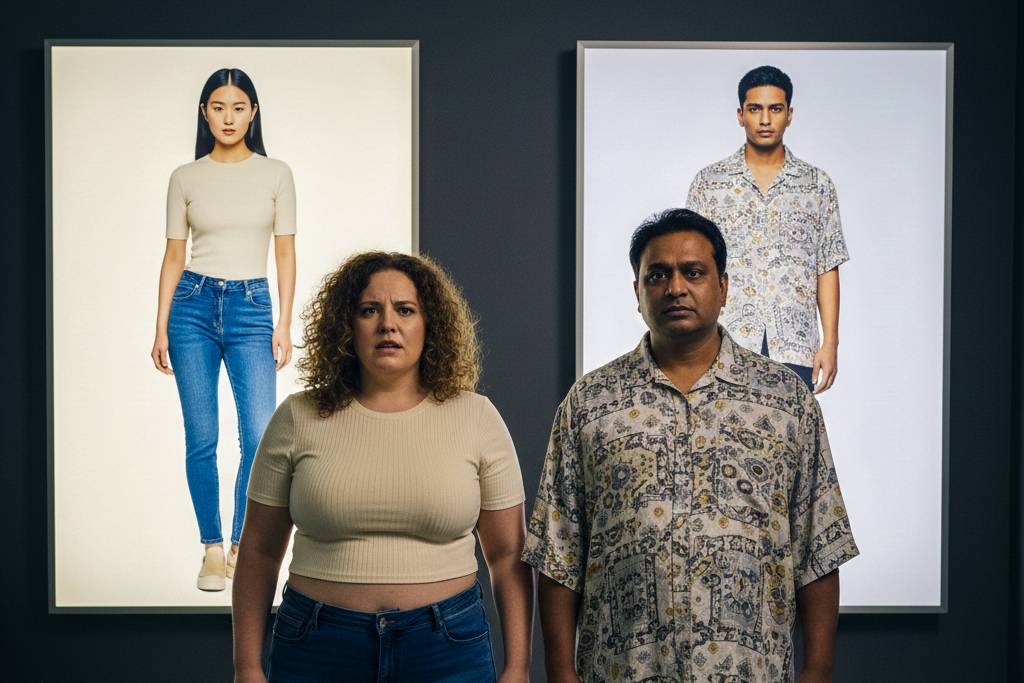
It could be called a classic illusion: if clothes look good on a perfect body, they will look good on you too. This belief is not only misleading — it is a commercially profitable marketing trick based on people’s desire to satisfy their own inadequacies.
It is the ideal tool to use in shop windows and advertisements. They do not show “average” bodies, real flaws, or the anatomy of real people. What you see is an adjusted, edited, and often unrealistic body. Not because the clothes are better, but because a perfect body hides the flaws in the clothes. On a person with a perfectly proportioned body, any outfit looks “right” — even one that in reality does not suit most people.
The problem arises when people think that clothes will transfer their visual effect onto them. But clothes do not transform the body. Clothes cannot change the anatomy, proportions, silhouette, or how they match a particular person’s appearance. Take, for example, a model with an athletic build and broad shoulders — the same clothes will look completely different on a person with narrow shoulders and wide hips — two completely different worlds.
The reality is harsh but simple: clothes should be chosen according to your body, not according to a picture. If something doesn’t suit your shape, neither the brand, the price, nor the trends will change that. Therefore, a more sensible solution is not to try to imitate the ideal, but to understand your own proportions — your shoulder line, waist position, height, and what fabric suits your body shape.
Once you accept this, disappointment and unnecessary purchases disappear. Fashion becomes a tool, not an illusion. And everything starts to look better — not because you have “approached” the model’s figure, but because you finally choose clothes that correspond to reality, not marketing fantasies.