

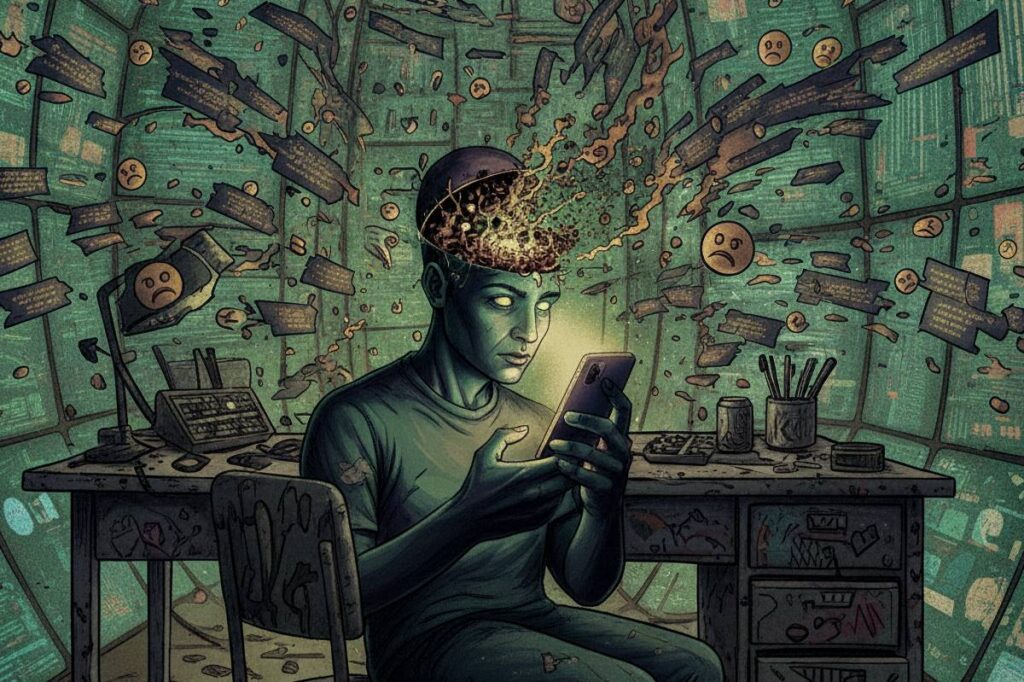
When opening one of the most popular short-form video platforms, after just a few minutes I got the feeling that the content was complete trash. And who do you think would consume such content? Yes – intellectual trash. Sometimes loud statements need to be generalized, because otherwise they are not loud enough.
Social networks are not, by their very nature, thought-provoking environments. They are designed for engagement. This difference explains almost everything that happens to people on them. It is not thought that wins engagement, but reaction to what is seen. Not a reasoned opinion, but an impulsive reaction. As a result, people turn into intellectual trash — not because they are stupid, but because the environment systematically selects the worst content.
An intellectual trash is not a person without an education. It is a person who:
- expresses opinions without justification,
- repeats other people’s phrases rather than forming their own thoughts,
- reacts emotionally rather than analyzing or using facts.
This situation on social media is not accidental. It is a logical outcome.
Algorithms do not promote the dissemination of accurate explanations of events. They promote content that provokes anger or a sense of belonging. A long, structured argument loses out to a short statement. Precise wording loses out to a loud phrase. Doubt loses out to conviction. People adapt to their environment.
The format determines thinking. If a thought cannot be expressed in 10-30 seconds, it is discarded. If it requires defining concepts, it is not used. If it requires prior knowledge, it does not elicit engagement. As a result, people stop trying to think in complex ways. They start thinking the way they are required to.
The “like” system reinforces this position: popular is confused with correct. The majority becomes the criterion. But the majority is rarely a measure of intelligence. On social networks, this paradigm is automated.
The apparent anonymity and distance from what is happening suppresses the sense of responsibility. People can write anything without checking, explaining, or justifying it. Criticism is perceived as an attack, not as additional information for discussion.
Over time, people no longer form their own opinions. They “borrow” them from others. From their own information flow, from their own bubble, from the loudest source. When opinions are threatened by facts, the facts are rejected.
The consequences are noticeable:
- reduced ability to concentrate,
- inability to argue logically for more than a few lines,
- confidence without competence,
- aggression as a substitute for thinking.
Important: social networks are not a problem in themselves. The problem lies in how they are used. People who use them as their main source of information inevitably degrade their intellectual qualities.
The solution is not simple. It involves:
- consume less, write more yourself,
- read full texts rather than fragments,
- do not engage in discussions based on emotions.
Thinking is a skill that must be trained. Social networks do not promote this skill. If a person does not consciously develop it, they become what the environment demands of them: an intellectual trash.