

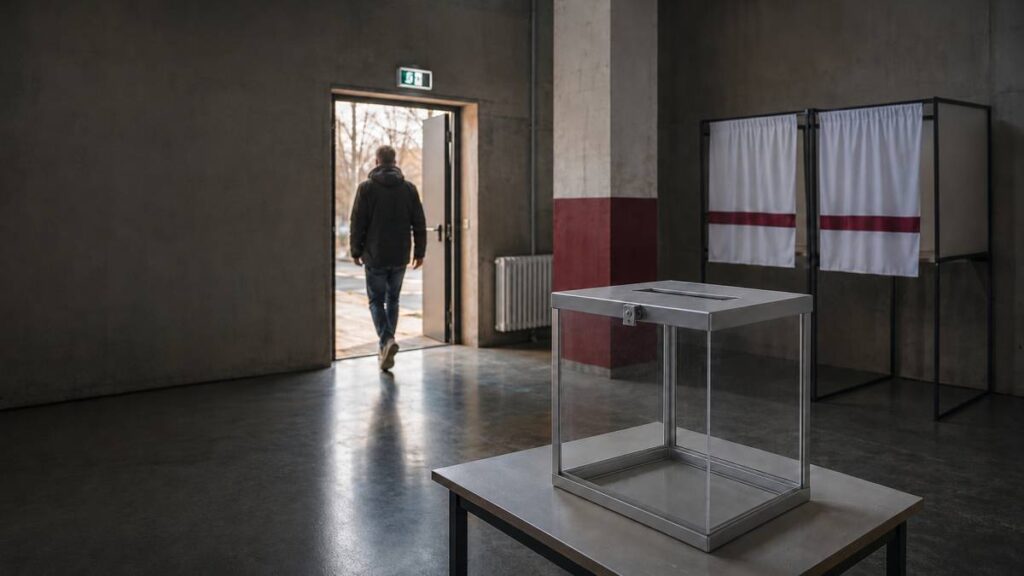
I am referring to elections in which those who exercise political power – supposedly as representatives of the people – are chosen. I do not take part in them.
Not because I do not care about what happens in Latvia. I do not participate because none of the political options gives me sufficient reason to entrust any party with state power for a full term in office.
My vote is not something I owe
Politicians are not automatically entitled to my vote. It is not a tax, a test of citizenship or an admission ticket to the right to criticise the government.
A vote expresses trust in a specific list of candidates. Without trust, there is no vote.
I do not help parties inflate their support figures so that, on election night, they can talk about “a mandate from the public”. If no one has earned my trust, my answer is no.
The lesser evil is still evil
I am told to choose the lesser evil. I refuse.
Election results do not record that I voted with disgust, out of fear or merely to prevent someone else from winning. They simply show a vote for a particular party.
The party counts that vote as support. It does not mention that the voter distrusts it and considers it merely the least bad option.
If I support no one, I do not pretend otherwise.
Election promises are not contracts
Before an election, parties make promises. Those promises are not legally binding contracts.
When those promises are broken, I cannot withdraw my vote, recall an individual representative or force the party to do what it promised. Politicians receive offices and mandates, while voters receive explanations about compromises, changing circumstances and objections from coalition partners.
Accountability ends with being told to vote for someone else next time.
The party receives real power. The voter receives yet another promise to choose more carefully next time.
I do not choose the government
In elections, I do not directly choose the prime minister, the ministers or the governing coalition. I choose a single list of candidates.
The parties then decide among themselves who works with whom, who remains in opposition and which campaign promises are discarded in the name of compromise.
Parties that publicly attack one another sit calmly around the same negotiating table after the election. The voter takes no part in those negotiations.
Yet the final arrangement is presented as the will of the people. It is not my direct choice. It is an agreement between parties reached after the votes are cast.
A single ballot paper grants an unchecked mandate
With a single ballot paper, I am expected to endorse an entire package of policies.
I cannot vote separately on taxes, healthcare, education, security and public spending. I have to accept the entire package, even when much of it is unacceptable to me.
My vote is then used to justify decisions that I do not support and that no one asks me about.
I do not issue a blank cheque simply because this is the established practice.
I do not have to vote to earn the right to criticise
The phrase “if you don’t vote, don’t complain” is cheap manipulation.
I pay taxes, obey the law and live with the consequences of decisions made by the state. I have the right to criticise those in power regardless of whether I participate in elections.
A country is not a private club where people earn the right to speak only after placing a ballot paper in a box. Political decisions also affect those who give none of the politicians their mandate.
Not voting does not mean surrendering the right to demand accountability.
“Others will decide for you” is not a sufficient argument
Yes, my non-participation does not invalidate the election. Seats are allocated on the basis of the votes cast, and committed party supporters gain greater influence.
I understand that fact.
But fear of other people’s choices does not turn a bad offer into a good one. I do not sign a bad contract simply because otherwise someone else makes the decision without me.
Besides, politicians make decisions without me after the election in any case. I do not participate in coalition negotiations, the selection of ministers, the allocation of the budget or MPs’ day-to-day votes. My direct influence ends at the ballot box.
Placing a ballot paper in a box is not political responsibility
A person does not become a responsible citizen merely by visiting a polling station on election day.
If they do not then follow the work of their elected representatives, request documents, scrutinise public spending or speak out against obvious nonsense, their political participation lasts only a few minutes.
I do not vote, but I continue to demand explanations, analyse decisions, track how taxpayers’ money is spent and publicly criticise those in power. That is more than mechanically placing a ballot paper in a box and remaining silent for years.
If you want my vote, earn it
I do not owe political parties my vote. Political parties owe the public an explanation of why they deserve power at all.
I want specific, measurable promises, deadlines, proper costings and clear accountability for failure. I want to see the reasoning behind decisions and where the money goes, not yet another collection of slogans about growth, security and putting people first.
“Vote for us because the others are even worse” is not an offer.
I do not vote in elections because no one has earned my trust. I say so openly instead of giving my vote to someone I do not believe in and then lying to myself that I have fulfilled a duty.