

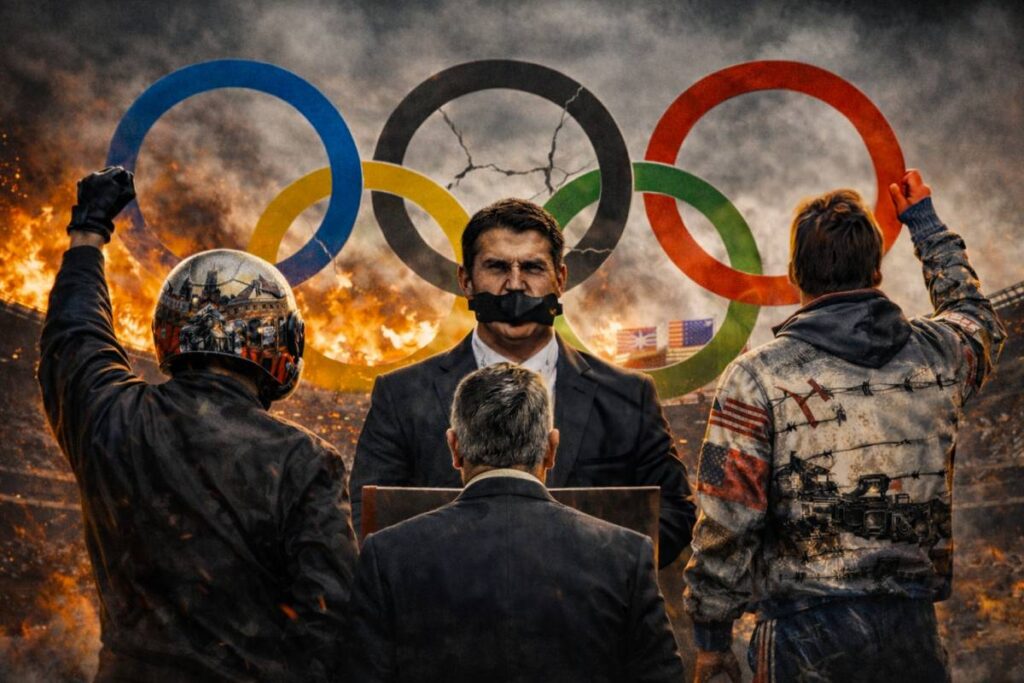
The Olympic Games are publicly presented as apolitical – a celebration of sport in which politics is seemingly excluded. This claim is a convenient narrative for viewers, but it does not correspond to reality. In essence, the Olympic Games are a tool for satisfying political interests. Countries do not invest huge amounts of money in the Olympic movement to take care of athletes health or the development of sport. The main goal is soft power in a global context. Medals are not just sports statistics, they are a political measuring tool.
Political neutrality
The Olympic Games management formally maintains a position of political neutrality, but this neutrality is more illusion than reality. The Games themselves are a political event: the choice of venue, demonstrations at the venues, or national flags.
However, alongside this political reality, there are strict rules prohibiting athletes from making political statements. Equipment must not bear symbols or messages that could be interpreted as having political undertones. This also applies to depictions of historical events if they involve condemnation, conflict or moral messages.
Selective morality
Many would agree with the statement that “politics is not allowed,” but as soon as the topic turns to personal matters, reasons for exceptions will be found. This is a limited ability to rationally evaluate events based on their essence. It is important to repeat this once more: it is a limited ability to rationally evaluate events based on their essence. If politics is not allowed, then it is not allowed for anyone. If it is allowed, then it is allowed for everyone.
Rational decisions will not always be emotionally pleasant, but actions must be consistent.
And finally, why is politics restricted at the Olympic Games? The ban on politics is a control mechanism. If politics were freely allowed, the Olympic sporting environment would turn into a propaganda battlefield, where competition would become secondary.