

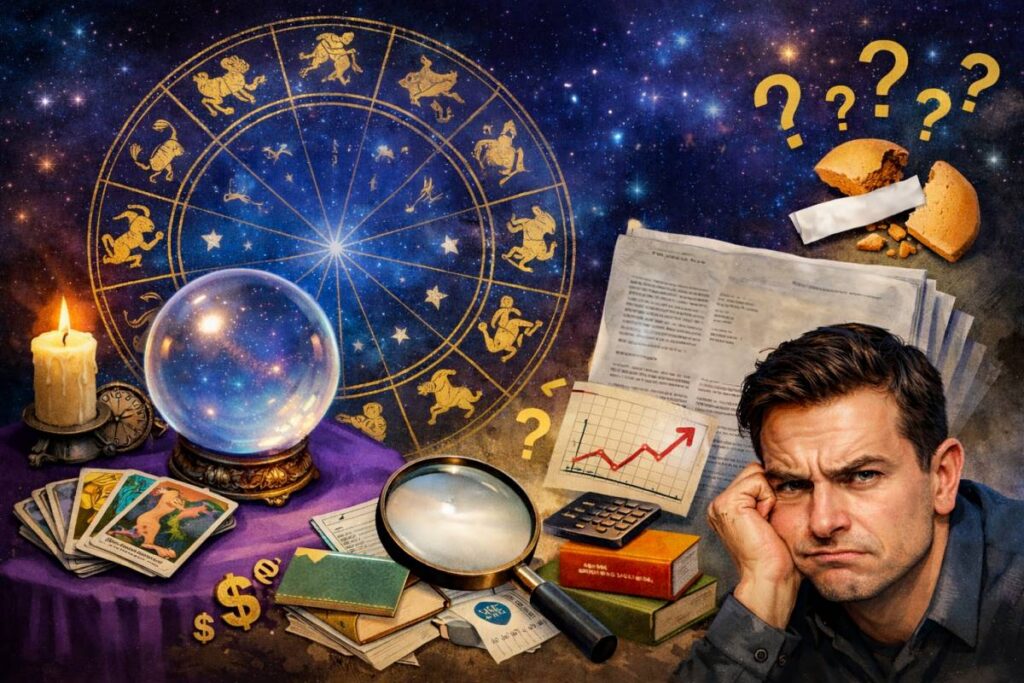
Astrology is a tradition – based interpretation of the influence of the position of the stars on human destinies and events on Earth. Although modern official science considers astrology to be pseudoscience, it has many followers, and astrological forecasts are regularly published in the media. It is not based on verifiable data, has no predictive value, and its claims do not stand up to criticism. And yet astrology remains popular. Why? Because it is useful nonsense.
Why astrology doesn’t work
There is no evidence that the position of planets or stars influences human character, decisions, or the course of events. Astrological descriptions are general and can be adapted to almost anyone. They are based on human psychology, which is also successfully used in other areas of life, for example, to sell you things you don’t need. Astrology does not provide knowledge about reality.
Why do people think it works
People like certainty. Astrology offers a simple explanation for a complex world. It seems to explain personality traits or relationship problems, even if these explanations are very general. General statements create a sense of “understanding,” and responsibility is shifted to external forces. The result is an illusion of certainty.
If a person realizes that it is not true, there is no harm done. Astrology can only be useful within a certain framework:
- As entertainment.
- As a topic of conversation.
- As a cultural phenomenon.
If you start taking it seriously, it becomes a harmful phenomenon:
- When decisions about health, finances, or relationships are based on it.
- When it is presented as knowledge.
- When critical thinking is replaced by horoscopes.
- When failures are justified by saying “It was meant to be”.
Astrology is not real. It explains nothing and predicts nothing. But it works as a psychological tool for people who are looking for simple answers. That is why astrology is a useful nonsense – as long as it is not turned into a substitute for reality.